

Cordillera Career Development College (CCDC) recognizes that quality education and environmental responsibility are closely connected. In the mountain communities of Benguet, protecting forests, habitats, agricultural landscapes, and water resources is essential to the well-being of people and the ecosystems on which they depend. Through campus practices, educational outreach, and community collaboration, the College advances the aims of Sustainable Development Goal 15: Life on Land.
The College’s reported initiatives reflect an approach that links environmental awareness with practical stewardship. Its activities range from land-conservation efforts at Admiral’s Farm Park to biodiversity-sensitive planning, sustainable food practices, and community-based learning on agriculture and tourism.
Learning through conservation and community engagement
A key feature of CCDC’s environmental engagement is Project SAGIP at Admiral’s Farm Park, identified in the College’s institutional records as an initiative promoting land conservation and responsible use of natural spaces. The park provides a setting for connecting sustainability discussions with the landscapes and ecosystems that learners and communities encounter in everyday life.
CCDC also reports free educational outreach on ecosystems, including the importance of wild plants and animals, as well as community-oriented activities related to sustainable agriculture and land management. Its community gardening outreach connects ecological responsibility with practical approaches to food production and land care. Work with partners in Atok, together with faculty research, extends this perspective to community-driven sustainable tourism, where conservation and local livelihoods can be considered together.
Protecting biodiversity through policy and practice
The College reports efforts to maintain and extend existing biodiversity through reforestation and habitat stewardship. Its approach includes policies for the conservation, restoration, and sustainable use of terrestrial ecosystems, with particular relevance to the forests and mountain environments surrounding its campuses and partner communities.
Environmental considerations are also reflected in campus planning and development. CCDC reports incorporating local biodiversity into development decisions, adopting measures to reduce the impacts of non-native species, and establishing a policy foundation for identifying and protecting threatened species and their habitats. These commitments support more deliberate decisions about how institutional facilities and activities interact with the natural environment.
Partnerships are central to this work. By collaborating with local communities to maintain shared land ecosystems, CCDC positions environmental stewardship as a collective responsibility rather than an activity confined to the campus.
Responsible consumption and waste management
Protecting life on land also requires attention to everyday institutional operations. CCDC reports policies and practices intended to reduce plastic waste, manage hazardous waste responsibly, and protect water quality through appropriate discharge standards and waste-management procedures. These measures address potential pathways through which campus activities could affect soil, waterways, wildlife, and surrounding communities.
The College further reports policies encouraging sustainably farmed food on campus. Together, these practices connect purchasing and consumption decisions with broader environmental goals, reinforcing the principle that ecosystem protection depends on both conservation projects and routine operational choices.
A snapshot of reported SDG 15 engagement
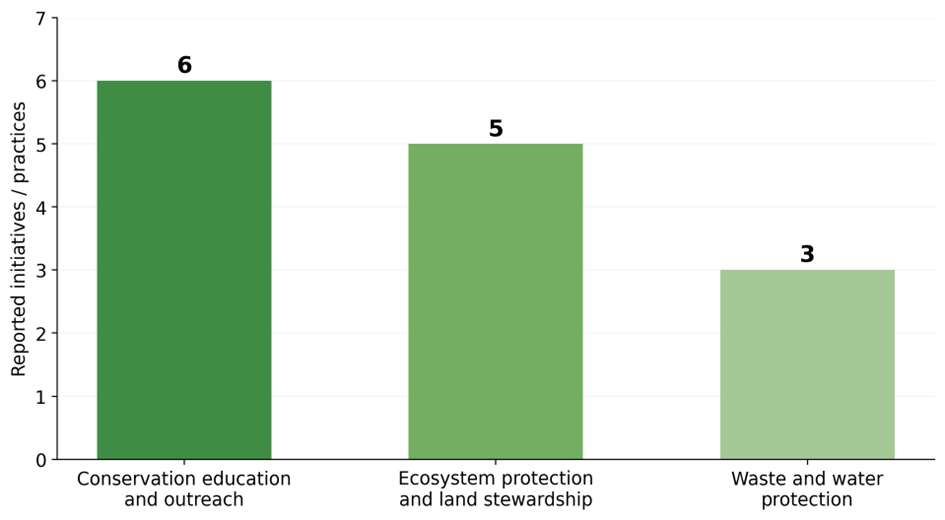
The institutional data identify 14 reported initiatives or practices across three broad areas of engagement. The graph below groups these documented commitments for communication purposes; the figures indicate the number of reported items, not the scale of ecological impact or the number of beneficiaries.
Sustaining the commitment to life on land
CCDC’s SDG 15 efforts demonstrate how a higher education institution can bring together teaching, community engagement, institutional policy, and campus management in support of terrestrial ecosystems. By combining conservation education, habitat stewardship, sustainable land use, and responsible waste practices, the College seeks to build environmental awareness while strengthening relationships with the communities that share these landscapes. As these efforts continue, documenting outcomes such as restored or maintained areas, species observations, outreach participation, and reductions in waste will help communicate their long-term contribution more clearly. CCDC remains committed to fostering an institutional culture in which caring for land and biodiversity is understood as an essential part of education and community responsibility.
