

Sustainable development is not the work of a single office, classroom, or institution. It grows through shared responsibility: educators opening opportunities for learners, students serving communities, employees improving campus practices, and partners bringing expertise and resources to common challenges. For Cordillera Career Development College (CCDC), this understanding connects the first sixteen Sustainable Development Goals (SDGs) to the seventeenth—Partnerships for the Goals.
Drawing together CCDC’s individual sustainability reports and institutional data collection, this annual feature presents a picture of how education, research, extension, campus operations, and cooperation can reinforce one another. The activities and measures described below represent reported initiatives and selected institutional baselines, rather than a claim that every SDG target has been achieved.
Education as a pathway to opportunity and human well-being
The College’s work on No Poverty (SDG 1) and Zero Hunger (SDG 2) begins with the recognition that students’ basic needs influence their ability to participate and succeed. Financial assistance, pathways into higher education, food-related support, responsible campus food services, and connections with agricultural communities form part of the institution’s reported approach. These efforts link educational access with livelihoods, nutrition, and the everyday realities of families in Benguet.
Good Health and Well-Being (SDG 3) is advanced through health-related academic programmes, student support, wellness initiatives, and community-facing health activities. Quality Education (SDG 4) provides the foundation for these efforts: CCDC reports teacher preparation, professional and vocational learning, community access to learning resources, and outreach that extends learning beyond formal classrooms.
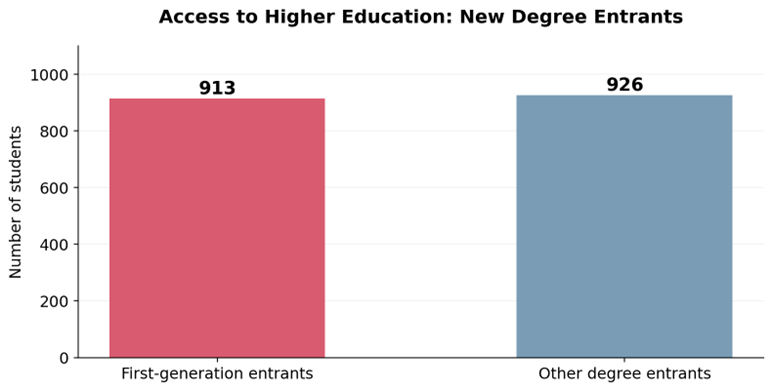
Equity is a continuing theme. Under Gender Equality (SDG 5), CCDC examines women’s participation in admission, graduation, and academic leadership alongside supportive institutional practices. Under Reduced Inequalities (SDG 10), its data record 913 first-generation students among 1,839 new degree entrants, or approximately 49.6%. The College also reports 19 students with disabilities among 4,688 students and four employees with disabilities among 383 employees. These figures help identify where access is taking place and where more inclusive support and measurement are needed.
Building a more resource-conscious campus
Environmental sustainability connects the College’s daily operations with the surrounding mountain communities. For Clean Water and Sanitation (SDG 6), CCDC reports water-conscious campus practices, water reuse efforts, sanitation management, and education on responsible water use. Its work on Affordable and Clean Energy (SDG 7) and Climate Action (SDG 13) includes monitoring energy consumption, encouraging efficiency, and engaging learners in climate awareness and community resilience.
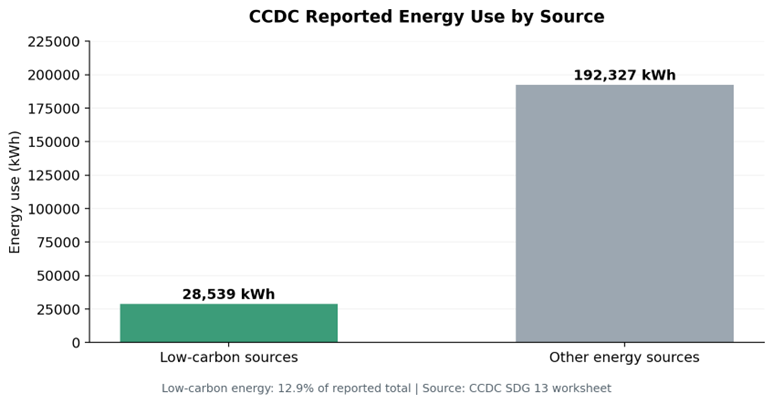
The institutional energy dataset records 220,866 kilowatt-hours of total energy use, including 28,539.09 kilowatt-hours attributed to low-carbon sources—approximately 12.9% of the reported total. This is a baseline for improvement, not a verified greenhouse-gas reduction or a carbon-neutrality claim. The separate floor-space energy measure should be reconciled with the kilowatt-hour total before it is used for comparative reporting.
Responsible Consumption and Production (SDG 12) is visible in reported efforts to limit single-use plastics and disposable materials, segregate and track waste, manage hazardous materials, encourage recycling, and apply waste-minimization expectations to service providers and suppliers. Food monitoring, reuse of paper, and sewage-treatment practices illustrate how operational decisions can support wider environmental goals. These measures also complement the College’s reported stewardship of waterways and aquatic ecosystems (SDG 14) and its land and biodiversity initiatives (SDG 15), including conservation-oriented activities at Admiral’s Farm Park and environmental learning with communities.
Connecting decent work, innovation, and sustainable places
The College’s contribution to Decent Work and Economic Growth (SDG 8) includes reported commitments to fair treatment, workplace rights, and employment stability, together with work-based learning. Institutional data record 763 student placements lasting more than one month and 178 employees on contracts longer than 24 months out of 383 employees. These figures should be read within their respective reporting definitions and periods.
Industry, Innovation and Infrastructure (SDG 9) is addressed through academic expertise, research, applied learning, and links with external organizations. The relevant dataset records 103 academic staff across selected subject categories, providing a snapshot of capacity rather than a direct measure of innovation outcomes. For Sustainable Cities and Communities (SDG 11), CCDC describes public-facing learning and recreational spaces, attention to Cordilleran cultural heritage, accessibility, and thoughtful campus development. Together, these activities emphasize that a college can be both an educational institution and a community partner.
Strengthening institutions, participation, and public service
Peace, Justice and Strong Institutions (SDG 16) draws attention to governance, integrity, student participation, academic freedom, civic dialogue, and cooperation with public institutions. CCDC’s reported graduating cohort includes 446 graduates from law- and civil-enforcement-related programmes out of 763 graduates, approximately 58.5%. The College also identifies community and government collaboration, student organizations, and civic education—including a candidates’ forum—as ways to encourage informed and responsible citizenship.
Across these areas, the central lesson is that institutional policies are most meaningful when they are translated into learning experiences, accessible services, consistent campus practices, and opportunities for communities to participate.
SDG 17: Turning individual efforts into shared progress
Partnerships for the Goals provides the thread that connects this work. Collaboration with local government units, community organizations, schools, professional networks, and international academic counterparts can strengthen research, extension, student volunteering, knowledge exchange, and responses to community needs. CCDC’s reported initiatives—from health outreach and agricultural engagement to environmental activities, civic dialogue, and academic exchange—show the breadth of opportunities for cooperation across sectors.
The College’s international academic engagements, including exchanges with institutions in Indonesia, offer additional avenues for sharing educational practices, discussing sustainability, and exploring future collaborative work. Such relationships are most valuable when they move beyond ceremonial agreements toward documented activities, shared outputs, and benefits for students and communities. The current SDG 17 data does not yet provide complete evidence for every partnership indicator, so this report presents collaboration as an institutional direction supported by examples from the SDG reports, not as a fully verified inventory of partnerships.
Publishing individual SDG reports and a consolidated sustainability article is itself an important step toward transparency. It allows the institution to communicate what it is doing, identify evidence gaps, invite constructive engagement, and make its commitments more visible to stakeholders. Publication should be accompanied by clear reporting periods, approved supporting records, and periodic updates to quantitative data.
The road ahead: from activities to measurable impact
CCDC’s next opportunity is to connect its many initiatives through a consistent sustainability framework. This means identifying responsible offices and community partners, aligning annual key result areas with relevant SDG outcomes, recording participation and beneficiaries, monitoring resource use over time, and evaluating what changes because of each intervention. It also means distinguishing implemented programmes from proposed policies and draft articles, and confirming data definitions before public release.
The seventeen goals are interconnected: educational access can reduce inequality; health and food security can improve learning; resource efficiency can strengthen climate action; and transparent institutions can make partnerships more effective. By linking campus action with local priorities and meaningful collaboration, CCDC can continue building a sustainability culture that is practical, inclusive, and accountable. Ultimately, sustainable development is a shared journey. When CCDC works with students, employees, communities, government agencies, and fellow educational institutions, each partnership becomes an opportunity to turn knowledge into service—and individual commitments into collective progress.
