

Cordillera Career Development College (CCDC) recognizes that quality education and decent work are closely connected. Beyond preparing students for professional careers, the College seeks to sustain a workplace where employees are treated fairly, their rights are recognized, and opportunities for growth are supported. Its contribution to Sustainable Development Goal 8 brings together institutional employment commitments, investment in its operations, and practical learning opportunities that help students transition from the classroom to the workplace.
Promoting Fair, Safe, and Inclusive Employment
CCDC reports commitments to paying staff and faculty at least the applicable living-wage benchmark, preventing workplace discrimination, and respecting freedom of association and collective bargaining. The institution also identifies protections against forced labor, human trafficking, and child labor, together with expectations that workers engaged through outsourced services receive equivalent rights. These commitments reflect an institutional approach to decent work that extends beyond direct employment relationships.
Fair compensation and transparent employment processes are also part of this approach. The College reports a policy commitment to equitable pay scales, including attention to gender-based pay disparities, as well as mechanisms for tracking pay equity and allowing employees to appeal matters involving pay or employment rights. These measures are reported institutional practices; their implementation and outcomes should be supported by current policies and personnel records.
Strengthening Employment Stability
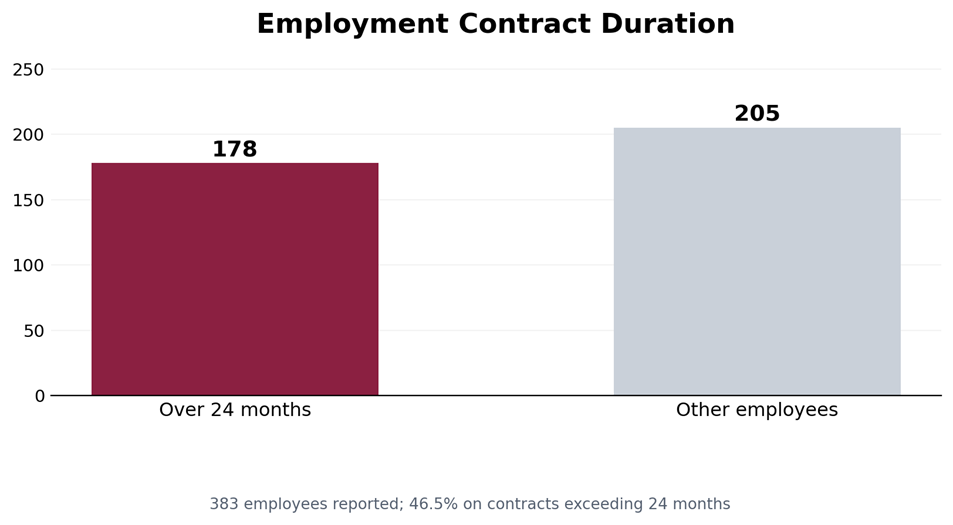
The institutional data record 383 employees, of whom 178 held contracts extending beyond 24 months. This represents approximately 46.5% of reported employees. The remaining 205 employees are not identified in the data as having contracts exceeding that duration; this figure should not be interpreted as the number of insecure or temporary employees.
Connecting Education with Meaningful Work Experience
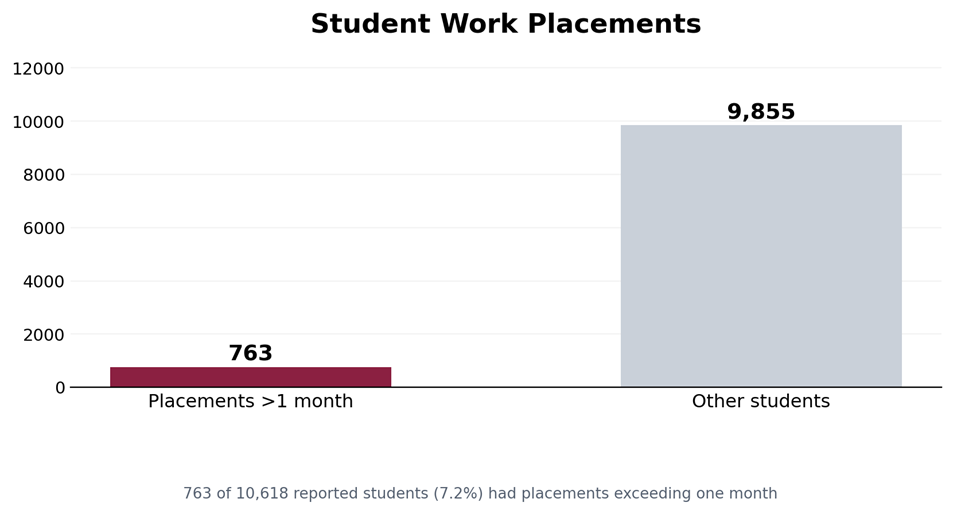
Work-based learning helps students connect academic knowledge with professional expectations, develop workplace habits, and explore career pathways. CCDC reports 763 students undertaking work placements lasting more than one month. Against the data’s reported student total of 10,618, this is approximately 7.2%. The figure is a descriptive ratio for the reported dataset and should not be interpreted as a graduate employment rate or as the proportion of students eligible for internships.
Institutional Resources and Sustainable Growth
The data reports university expenditure of ₱174,258,755.49 and 383 employees. These figures provide context for the scale of CCDC’s institutional operations and its role as an employer and educational provider. Expenditure is an institution-wide total, however, and should not be presented as a direct measure of spending on staff welfare or employment benefits without a verified financial breakdown.
Taken together, CCDC’s employment commitments and work-placement opportunities illustrate how an educational institution can contribute to a more inclusive local economy: by supporting fair treatment at work, building professional skills, and helping learners gain experience relevant to future employment.
Moving Forward
CCDC aims to strengthen the connection between its institutional policies and measurable results. Continued documentation of employment practices, contract arrangements, staff support, student placements, and partner engagement will help the College assess progress and communicate its contribution to decent work more clearly. In doing so, the College affirms that economic growth is most meaningful when it creates opportunities, protects dignity, and benefits both workers and learners.
