

Access to clean water, responsible sanitation, and the protection of water resources are essential to healthy and sustainable communities. Cordillera Career Development College (CCDC) supports these priorities through water management practices on campus, conservation awareness, and cooperation with communities and public institutions. Together, these initiatives reflect the College’s commitment to integrating environmental responsibility into institutional operations and community engagement.
Building a Water-Conscious Campus
CCDC reports institution-wide monitoring of water consumption as part of its efforts to understand and manage water use. Its SDG 6 data identify a campus population of 4,960, providing context for future per-person consumption reporting. The worksheet does not, however, provide a total water-volume figure. Accordingly, a reliable water-consumption-per-person rate cannot yet be presented.
The College also reports processes for wastewater treatment and for preventing pollutants from entering water systems, alongside access to free drinking water for students, employees, and visitors. Water-conscious building standards and landscape planting practices are identified as further ways to reduce unnecessary water demand.
Strengthening Water Reuse and Resource Efficiency
Water conservation extends beyond limiting consumption. CCDC reports having a policy to encourage water reuse and a process for measuring reused water. The College also identifies sustainable water-extraction practices where extraction is relevant to its operations. These measures provide a framework for responsible resource use, while more detailed measurements would allow CCDC to communicate the volume of water conserved or reused in future reports.
Taking Water Education Beyond the Campus
The College’s commitment to clean water also reaches the wider community. Its SDG 6 worksheet records free educational opportunities on good water management, practical support for off-campus conservation, and cooperation with government partners on water security. CCDC additionally reports activities that promote conscious water use both within the campus and in surrounding communities.
Through these complementary efforts, the institution positions water stewardship as a shared responsibility. Educational activities can help learners and community members recognize the importance of protecting water sources, preventing contamination, and adopting everyday conservation habits.
CCDC’s Reported Areas of Action
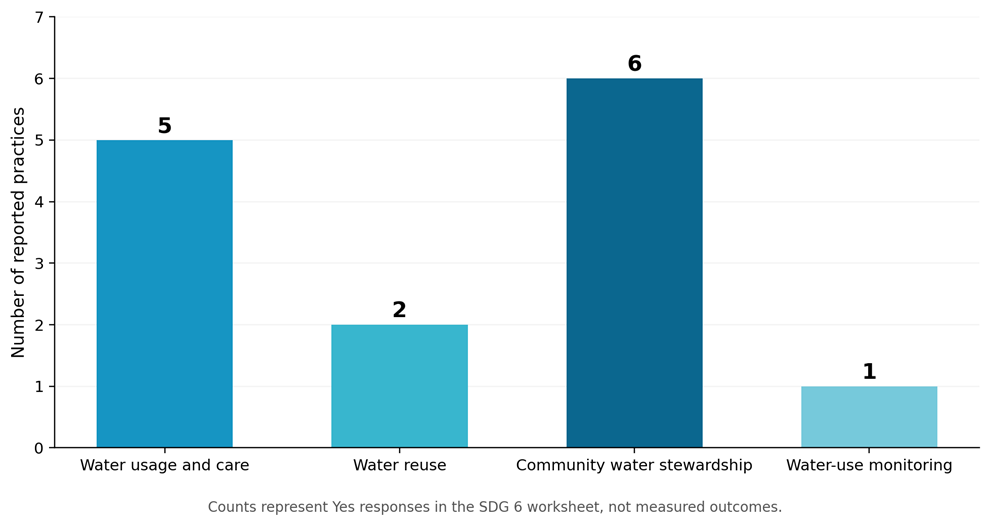
The following chart summarizes the number of practices recorded in each broad area of the College’s SDG 6 data. It describes the scope of reported institutional measures rather than the scale of environmental outcomes.
Looking Ahead: Measuring Water-Security Outcomes
CCDC’s reported policies and programmes provide a foundation for continued action on clean water and sanitation. To strengthen future public reporting, the College can consolidate annual water-consumption figures, record quantities of reused water, document conservation improvements, and report participation in community water-management activities. These measures would help demonstrate not only the presence of initiatives but also their results over time. By connecting responsible campus management with education and partnerships, CCDC seeks to contribute to a culture of water conservation that extends beyond the institution and supports the long-term well-being of communities in Benguet and beyond.
