

For 33 years, Cordillera Career Development College (CCDC) has remained committed to bringing quality education closer to the people. Located in La Trinidad, Benguet, the College serves students from communities where limited or seasonal household income can make higher education difficult to sustain.
Recognizing that access involves more than admission, CCDC combines scholarships and financial assistance with free student services, housing support, and academic and psychosocial interventions to help economically disadvantaged learners pursue their degrees.
Scholarships, Grants, and Financial Assistance
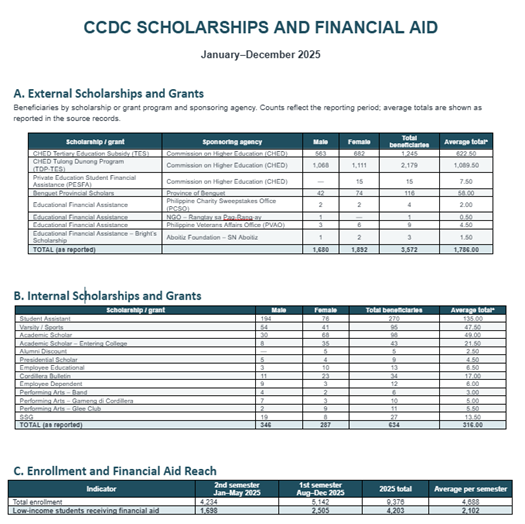
CCDC facilitates access to scholarships and grants from government agencies, private organizations, and nongovernment organizations, complemented by institutional financial aid.
In identifying students who may need assistance, CCDC considers socioeconomic indicators such as agriculture-based livelihoods, self-supporting status, Indigenous Peoples’ membership, disability, solo-parent status, and participation in the Pantawid Pamilyang Pilipino Program (4Ps). These indicators help identify potential need, while household income assessment remains important in determining membership in the bottom 20% of income groups.
In 2025, 1,786 students received external scholarships and grants, while 317 benefited from CCDC grants. Separately, institutional records indicate that an average of 2,102 low-income students per semester received financial aid, equivalent to approximately 45% of the average enrollment of 4,688 students.
Ayowan Program: Free Holistic Student Support
The Ayowan Program provides financial interventions, counseling, talk therapy, peer mentorship, and tutorial services to help students manage academic, personal, and emotional challenges.
In 2025, 308 students from the bottom 20% of household income groups accessed Ayowan support, with around 31 volunteer counselors, peer tutors, and mentors contributing to its services.
By complementing financial assistance with academic and psychosocial support, Ayowan helps students address challenges that may interfere with their studies.

Free Housing Assistance
To ease accommodation expenses, CCDC provides full and free housing to 75 deserving students who undertake after-hours caretaking responsibilities for school facilities. This arrangement reduces living costs while encouraging responsibility and service to the College community.
Free Medical and Dental Care
CCDC’s Medical and Dental Clinic operates 12 hours daily, six days a week. In 2025, it recorded 1,921 student service encounters involving free medical and dental care, including 360 dental concerns and 1,561 medical and health concerns. These figures exclude routine annual checkups.
The clinic helps reduce out-of-pocket health expenses and supports students’ well-being and academic participation.
Free Legal Assistance
Through its Community Legal Aid Center (CLAC), the CCDC College of Law provides free legal services to students, employees, and community members. In 2025, the Center served more than 100 students and community members, helping make legal assistance accessible to those who may have difficulty affording it.
Supporting Students Toward Graduation
In 2025, scholarship grantees and Ayowan beneficiaries reportedly recorded dropout rates of 8% and 5%, respectively. These figures provide a basis for monitoring retention, although they do not independently establish that the programs caused the outcomes.
CCDC continues to monitor student needs and provide complementary assistance to help learners overcome financial, academic, health, and personal challenges throughout their college journey.
For CCDC, bringing quality education closer to the people means more than opening the doors to admission. It means helping students overcome barriers, continue their studies, and work toward graduation.
