

Cordillera Career Development College (CCDC) recognizes that innovation is not limited to new technologies or commercial products. In higher education, it also begins with the people, knowledge, and institutional relationships that enable research, practical problem-solving, and meaningful engagement with industry and communities. In support of Sustainable Development Goal 9, the College continues to examine the academic capacity and systems needed to connect education with innovation and sustainable development.
Academic expertise as a foundation for innovation
CCDC’s institutional data collection records 103 academic staff across three reported subject-area categories: 11 in science, technology, engineering and mathematics (STEM), 80 in medicine or health-related fields, and 12 in arts, humanities and social sciences. These figures describe the reported distribution of academic personnel within the SDG 9 data collection and should not be interpreted as a measure of research productivity or industry impact.
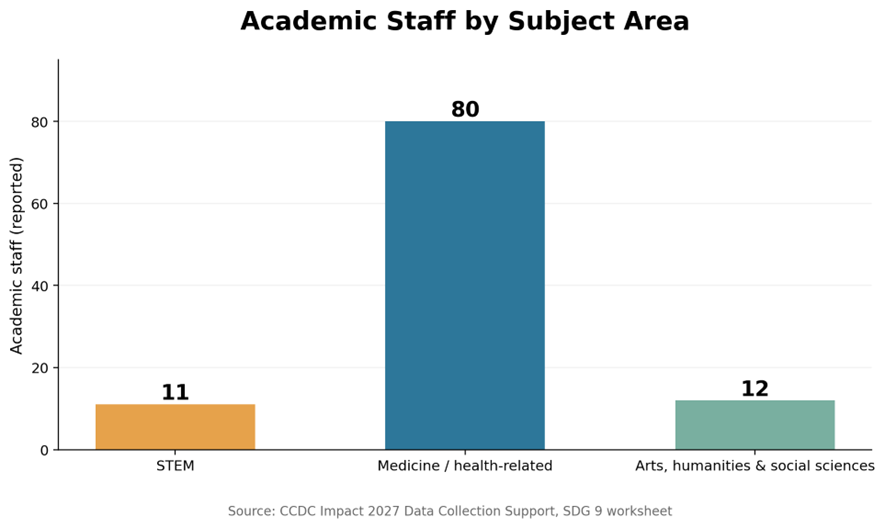
The range of disciplinary expertise represented in the data provides a potential basis for cross-disciplinary work. Health-related disciplines can contribute perspectives on service delivery and public well-being; STEM fields can support technical inquiry and evidence-based solutions; and the humanities and social sciences can help institutions understand social needs, communication, and the human dimensions of innovation. These are opportunities for collaboration rather than verified outcomes of specific CCDC projects.
Linking teaching, research, and practical application
For a career-oriented institution, a central contribution to sustainable development is preparing learners to apply knowledge in workplaces and communities. Industry-responsive curricula, faculty development, applied research, and partnerships with external organizations are possible pathways through which educational expertise can address practical challenges. Sustained progress requires clear documentation of activities, collaborators, outputs, and beneficiaries so that institutional commitments can be assessed over time.
The current SDG 9 data includes fields for university spin-offs and research income from industry and commerce, but no figures have been entered for these measures. Consequently, the available dataset does not establish a number of spin-off enterprises or a value of industry-funded research income. These measures remain important areas for future documentation and institutional reporting.
Strengthening the evidence for future progress
CCDC can strengthen future SDG 9 reporting by maintaining an institution-wide record of research collaborations, industry-supported studies, innovation projects, and any enterprises emerging from university work. Such records should distinguish proposed activities from completed projects and should capture dates, partner organizations, funding, outputs, and demonstrable benefits. A consistent evidence base will allow the College to communicate achievements with greater clarity and evaluate how academic work contributes to resilient industries and inclusive innovation.
Looking ahead
The academic staff profile presented in this report offers a starting point for understanding CCDC’s disciplinary resources. As the College advances its sustainability agenda, stronger connections among teaching, research, industry, and community needs can help translate institutional expertise into measurable contributions to SDG 9. Building those connections and documenting results will be essential to telling a credible and compelling story of innovation and development.
