

Peaceful and inclusive communities depend on institutions that uphold integrity, encourage participation, and make knowledge accessible. Cordillera Career Development College (CCDC) contributes to this shared responsibility through education, institutional governance, civic engagement, and collaboration with community and government partners. Its reported SDG 16 activities connect the daily work of the College with the wider pursuit of justice, accountable institutions, and informed citizenship.
Education for Public Service and the Rule of Law
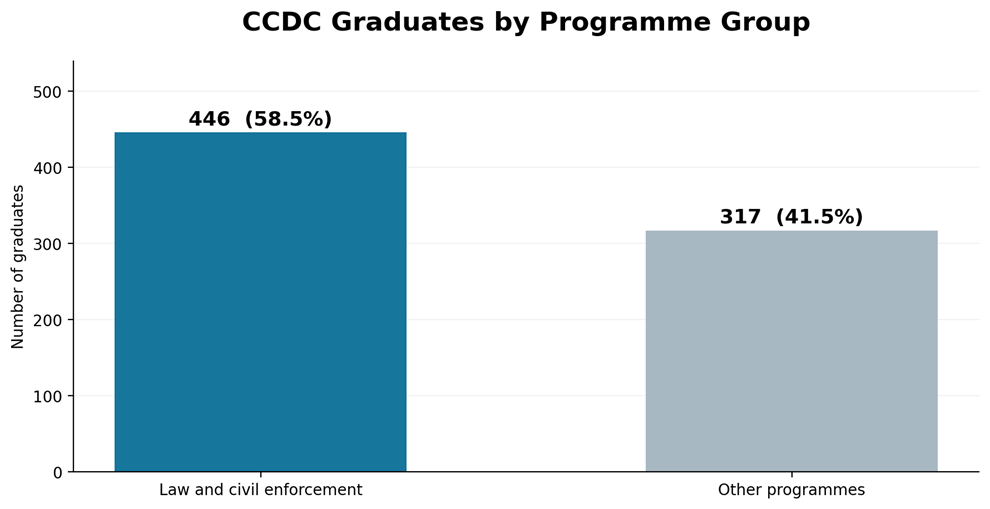
A significant dimension of CCDC’s contribution is preparing graduates for professions connected with law and civil enforcement. Institutional data record 763 graduates, including 446 from law- and enforcement-related programmes. This represents approximately 58.5% of the reported graduating cohort. These figures illustrate the scale of the College’s educational contribution in fields relevant to public safety, community protection, and the administration of justice; they do not, by themselves, establish graduates’ subsequent employment or professional outcomes.
Inclusive Representation and Student Participation
The College reports representation of students, faculty, and non-teaching staff in its highest governing arrangements. Its SDG 16 documentation also recognizes student organizations as avenues for participation, student support, and social engagement. Such structures provide opportunities for members of the academic community to contribute perspectives, raise concerns, and take part in campus life. Their value lies not only in representation on paper but in meaningful opportunities to be heard and involved in institutional decisions.
Integrity, Academic Freedom, and Institutional Accountability
CCDC identifies institutional commitments concerning corruption and bribery, academic freedom, stakeholder engagement, and the publication of financial information. These commitments reflect the importance of transparent procedures, ethical conduct, and responsible stewardship in educational institutions. Academic freedom is particularly important to the College’s teaching and research mission: it supports reasoned inquiry and the responsible exchange of ideas.
Working with Communities and Government
Beyond campus, the College reports engagement with local stakeholders and participatory mechanisms involving community and government representatives. Its records describe expert contributions at local and regional levels, outreach and capacity-building for public leaders, and policy-focused research in collaboration with government. These activities reflect the role of a higher education institution as a partner in addressing practical public concerns, sharing evidence, and helping communities develop informed responses to local challenges.
Encouraging Civic Dialogue and Informed Citizenship
The data also identifies CCDC’s voter education programme and candidates’ forum associated with the May 2025 elections as an example of convening civic dialogue. Educational spaces can help people examine public issues, listen to differing perspectives, and engage respectfully in democratic processes. In this way, civic education complements the College’s professional programmes and broader commitment to community engagement.
Sustaining the Commitment
CCDC’s reported efforts under SDG 16 show how governance, education, integrity, and community partnerships can reinforce one another. Looking ahead, the College can strengthen this contribution through clearer public documentation of stakeholder participation, approved policies, civic education activities, and measurable outcomes of its government and community partnerships. Continued evidence-based reporting will help demonstrate not only the existence of institutional initiatives but also their contribution to more inclusive and accountable communities.
