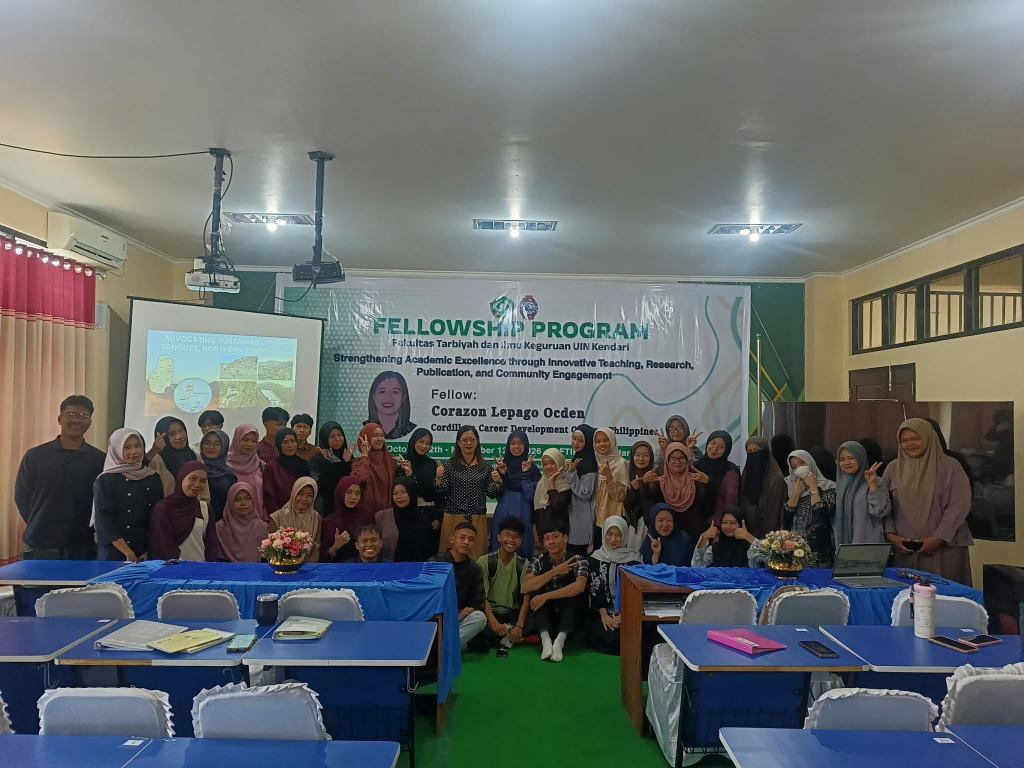

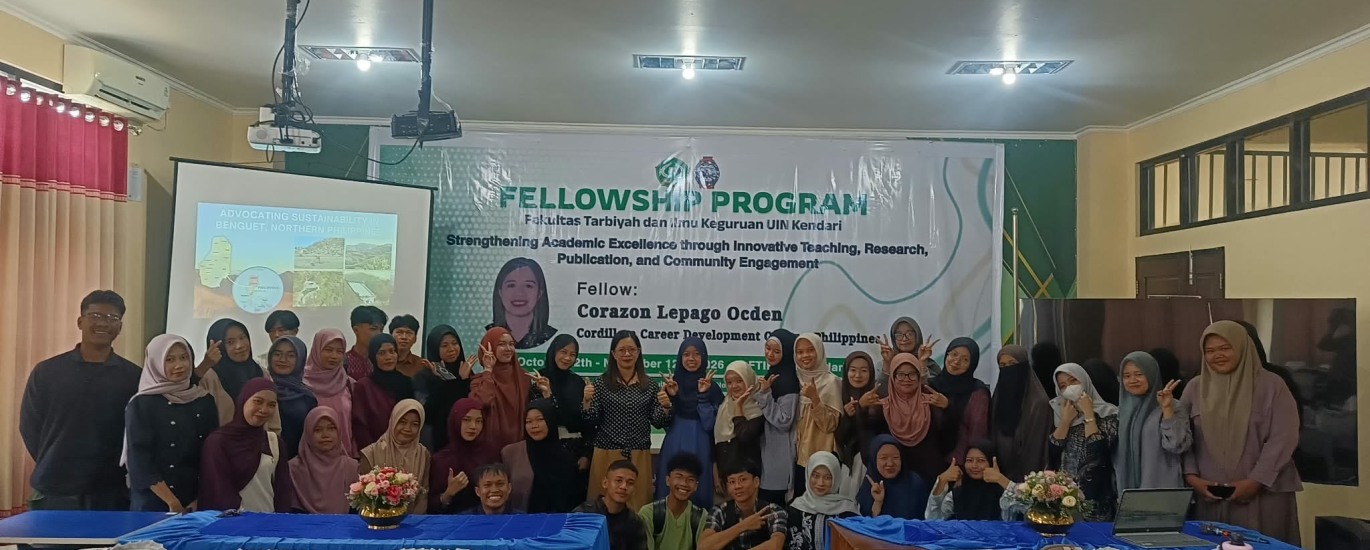
Cordillera Career Development College (CCDC) continued to strengthen its international academic engagement and commitment to sustainable development as Dr. Corazon L. Ocden, Quality Assurance Director and International Relations Representative of CCDC, delivered a lecture on sustainability to university students at the Faculty of Tarbiyah and Teacher Training (FTIK), Universitas Islam Negeri (UIN) Kendari, Indonesia, on October 26, 2026.
The lecture, entitled “Sustainability Starts With Us: Small Actions, Big Impact,” formed part of Dr. Ocden’s Fellowship Program at UIN Kendari, an academic engagement undertaken through the partnership between the two higher education institutions.
The session aimed to increase students’ awareness of environmental sustainability and encourage their active participation in achieving the United Nations Sustainable Development Goals (SDGs). It emphasized that sustainability is not solely the responsibility of governments and large organizations but also of educational institutions, communities, and individuals.
During the lecture, Dr. Ocden introduced the concept of sustainability and discussed its three interconnected dimensions: environmental protection, social well-being, and economic responsibility. She highlighted the importance of meeting present needs while safeguarding natural resources and opportunities for future generations.
Emphasis was given to SDG 6 (Clean Water and Sanitation), SDG 7 (Affordable and Clean Energy), SDG 12 (Responsible Consumption and Production), SDG 13 (Climate Action), SDG 14 (Life Below Water), and SDG 15 (Life on Land).
Through practical examples, students were encouraged to recognize how everyday practices—such as conserving water and electricity, reducing single-use plastics, properly segregating waste, and protecting natural ecosystems—can contribute to broader sustainability goals.
A significant part of the discussion featured CCDC’s institutional sustainability initiatives, demonstrating how higher education institutions can translate environmental commitments into concrete campus practices. These included the promotion of reusable materials and the reduction of single-use plastics, environmental protection activities, and institutional initiatives related to energy efficiency, renewable energy, and responsible wastewater management.
By sharing these examples, Dr. Ocden illustrated how institutional policies, student participation, and campus operations can collectively promote environmental stewardship and contribute to sustainable communities.
The lecture also introduced the role of higher education institutions in advancing the SDGs through their four major functions: instruction, research, community extension, and institutional operations. Students were encouraged to view universities not only as centers of learning but also as active contributors to addressing environmental and societal challenges.
Furthermore, Dr. Ocden discussed the significance of sustainability reporting and the Times Higher Education (THE) Impact Rankings, explaining how universities can document and assess their contributions to the SDGs through measurable initiatives, institutional policies, research outputs, and community engagement.
The session encouraged students to identify sustainability challenges within their own university and communities and propose practical, measurable solutions. Through this approach, the lecture reinforced the importance of transforming environmental awareness into responsible action.
The academic engagement also provided an opportunity to share Philippine higher education practices with Indonesian students, promoting cross-cultural learning and strengthening academic cooperation between CCDC and UIN Kendari.
Through its continuing international partnership and faculty engagement initiatives, CCDC reaffirms its commitment to quality education, internationalization, environmental responsibility, and sustainable development.
The lecture underscored a shared message: sustainability begins with individual responsibility, grows through collective action, and creates lasting benefits for communities and future generations.
As CCDC continues to expand its international academic partnerships, initiatives such as this reflect the institution’s commitment to developing globally engaged, socially responsible, and sustainability-conscious learners and educators.