

Cordillera Career Development College (CCDC) recognizes that addressing climate change requires collective action among educational institutions, local governments, communities, and other stakeholders. In line with its commitment to bringing quality education closer to the people, the College promotes climate resilience and environmental sustainability through community extension programs, disaster risk reduction initiatives, environmental awareness campaigns, and partnerships with local government units and community organizations.
Located in Benguet, where communities are exposed to typhoons, heavy rainfall, flooding, landslides, and other climate-related hazards, CCDC recognizes the importance of sharing knowledge and practical strategies that help communities prepare for environmental risks. Through its community engagement and institutional partnerships, the College contributes to local efforts to promote climate adaptation, disaster preparedness, environmental protection, and sustainable development.
Rather than treating climate action as an activity confined to the campus, CCDC advances a collaborative approach that encourages the participation of local government partners, schools, farmers, youth organizations, and community groups.
Sharing climate action through local partnerships
One important mechanism for CCDC’s collaboration with local stakeholders is its partnership with the Local Government Unit (LGU) of La Trinidad. Through a formal memorandum of understanding, the College and the LGU established cooperation in education, health, public safety, disaster risk reduction and management, and policy-driven research.
This partnership provides an avenue for sharing institutional knowledge, research capabilities, and community-based initiatives that can contribute to local development priorities. By working with the LGU, CCDC can help support evidence-based approaches to disaster preparedness, environmental management, and community resilience.
The collaboration also creates opportunities for faculty members and students to participate in research, extension activities, and capacity-building initiatives that respond to local needs.
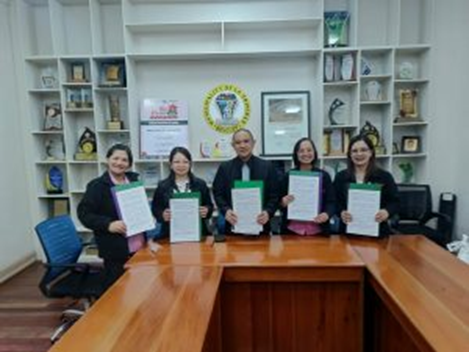
La Trinidad Mayor Roderick Awingan with Municipal Health Officer, Dr. Antonette Agpas and CCDC Officials led by President Sherry Junette M. Tagle sign a memorandum of agreement on strengthening research-based policy making on various areas to include disaster risk reduction, public safety, and sustainable development efforts.
A shared climate action framework for local communities
CCDC’s existing partnerships and community initiatives provide a foundation for a shared climate action framework that local government units, barangays, schools, farmers, and community organizations can use to identify environmental risks and coordinate practical responses.
The framework below consolidates documented CCDC activities into key areas for collaborative action. It is a proposed synthesis of the College’s existing initiatives, not a claim that CCDC has already adopted or formally distributed a standalone Climate Action Plan.
1. Climate and disaster risk awareness
Share educational materials with partner schools, barangays, and community groups on typhoons, heavy rainfall, flooding, landslides, and the importance of preparedness. Integrate climate awareness into community extension activities and student training.
2. Environmental protection and climate mitigation
Collaborate with local government and environmental partners on tree planting, waste management, land restoration, and responsible resource use. CCDC’s environmental partnerships and Project SAGIP provide relevant examples of activities that can be expanded through community participation.
3. Climate adaptation and resilient livelihoods
Work with farmers, households, and barangay organizations to promote sustainable gardening, local food production, and recovery measures for communities affected by extreme weather. CCDC’s HAPAG community gardening outreach and Operation Kajo offer practical examples of community-based approaches.
4. Research, policy sharing, and community monitoring
Share research findings with local decision-makers and community stakeholders, identify priority environmental concerns, and review progress through joint meetings and community feedback. CCDC’s La Trinidad LGU partnership supports research-driven policy development and sustainable local planning.
Working with communities beyond La Trinidad
CCDC’s collaboration with the Municipality of Atok through the CUBE Partnership further illustrates how institutional partnerships can support community-driven and sustainable development across the Cordillera region.
On September 12, 2025, CCDC and its partner academic institutions signed a three-year Memorandum of Agreement with the Municipality of Atok. The partnership brought together municipal officials, barangay leaders, and an Indigenous Peoples’ representative to advance inclusive and sustainable development.
This partnership offers a platform for sharing environmental knowledge and developing locally appropriate sustainability initiatives with government and community stakeholders.
CCDC’s environmental work also includes collaboration with the Department of Environment and Natural Resources (DENR) on tree planting and waste management, and with the Philippine Volunteers for Environmental Protection on environmental sustainability. These partnerships demonstrate how the College can connect education and community action with broader environmental stewardship.
Conclusion
CCDC’s climate action work is grounded in collaboration. Through its partnerships with local government units, community groups, schools, environmental organizations, and disaster management agencies, the College helps connect education and research with practical initiatives that support environmental protection and community resilience. By building on its existing programs in disaster preparedness, sustainable agriculture, tree planting, environmental stewardship, and research-driven local planning, CCDC can further develop and share a coordinated climate action plan with its partners. A formal plan could establish shared priorities, designate responsibilities, identify resources, and set measurable targets for climate education, mitigation, adaptation, and disaster risk reduction.
