
La Trinidad, Benguet — Cordillera Career Development College (CCDC) has demonstrated its commitment to the sustainable use, conservation, and restoration of terrestrial ecosystems during Academic Year 2024–2025 through a combination of institutional policy, legal partnership, and direct reforestation action.
While the College does not maintain a single standalone policy bearing the exact title of “terrestrial ecosystem conservation,” its environmental governance framework is anchored on enforceable policies and collaborative engagements that address land stewardship.
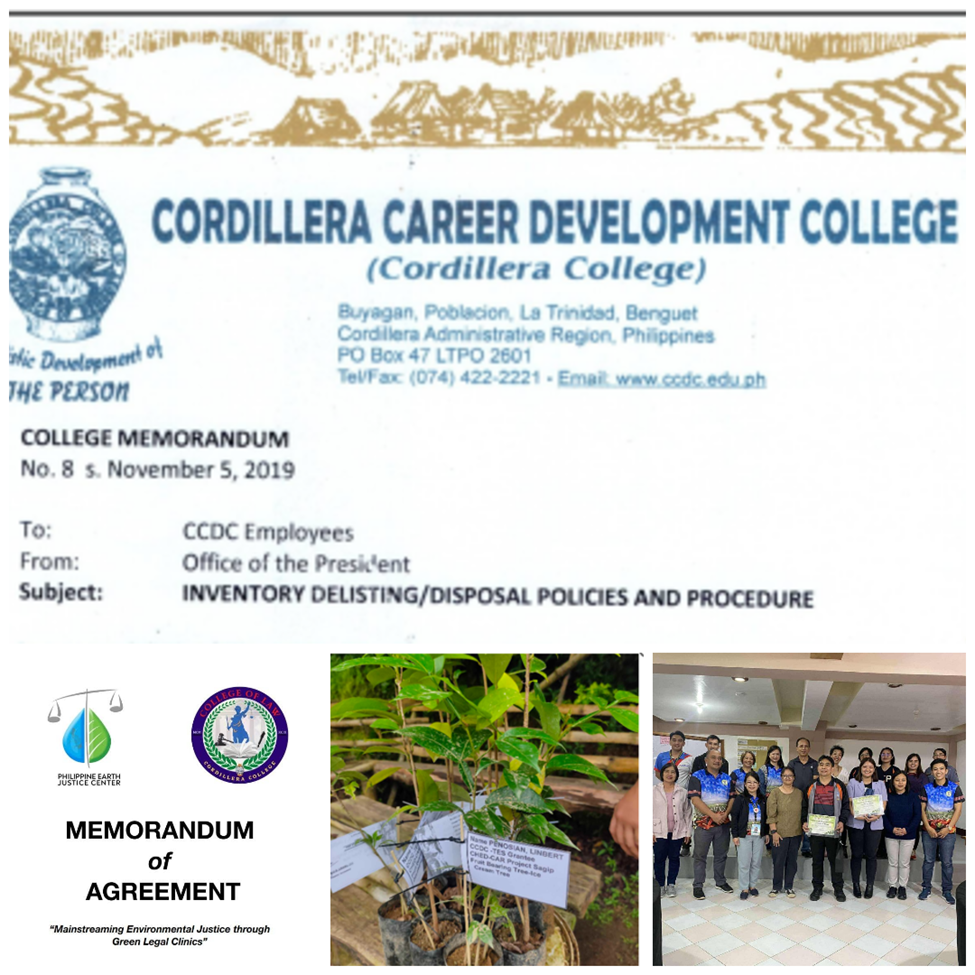
The College’s Waste Disposal and Landfill Policy, published in 2025, establishes a formal and enforceable framework for sustainable waste management in full compliance with Republic Act 9003 (Ecological Solid Waste Management Act of 2000). The policy strictly prohibits open dumping or burning on campus and implements measurable tracking of waste volumes, material recovery facilities, and source segregation — practices that prevent land contamination and support the health of surrounding ecosystems.
Complementing this policy is CCDC’s partnership with the Philippine Earth Justice Center, formalized through the College of Law in July 2023 and actively engaged through 2024. This collaboration is designed to ensure strengthened delivery of legal assistance aligned to the protection and enforcement of environmental laws and to address environmental justice issues in local communities. This partnership extends the College’s conservation reach beyond campus boundaries into community-level legal and policy support for environmental protection.
On the ground, Project SAGIP (Scholars and Grant-in-Aid Beneficiaries Action in Greening Initiative Program) directly contributes to land restoration and reforestation. A CHED-UniFAST Cordillera site visit on May 14, 2025, documented that approximately 300 seedlings — including avocado, coffee, mango, and pine trees — were planted at CCDC’s Admirals Farm Park, with coffee plants already showing signs of success and sustainability. Under the program, each financial assistance grantee is encouraged to plant at least one indigenous or fruit-bearing tree annually, and the initiative explicitly contributes to reforestation and environmental sustainability.
The College also participates in local land-use planning. In September 2025, CCDC faculty member Mr. Lourence Miguel was recognized by the Municipality of La Trinidad for contributing research outputs to the Land Use, Infrastructure, and Urbanism Sector under the Municipal Strategic Planning for the Comprehensive Development Plan 2026–2031. This engagement integrates academic research into municipal land-use policymaking, supporting sustainable development planning at the local government level.
Together, these policies, partnerships, and practices reflect CCDC’s institutional commitment to the conservation, restoration, and sustainable use of the land ecosystems under its stewardship and within its sphere of community influence.